| State Parks agrees to settlement in Castle Rock suit
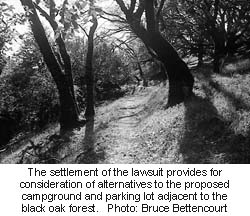 When the California Department of Parks and Recreation adopted an inadequate General Plan for Castle Rock State Park in 2000, the Sierra Club and a group called Friends of Castle Rock State Park filed suit to protect the park's fragile biological resources. The Department's plan focused heavily on preconceived notions of park design with no scientific analysis that would allow for more informed planning. When the California Department of Parks and Recreation adopted an inadequate General Plan for Castle Rock State Park in 2000, the Sierra Club and a group called Friends of Castle Rock State Park filed suit to protect the park's fragile biological resources. The Department's plan focused heavily on preconceived notions of park design with no scientific analysis that would allow for more informed planning.
The settlement provides for consideration of alternatives to the proposed campground and parking lot adjacent to the black oak forest. To ensure appropriate management decisions in the future, the Department of Parks and Recreation agreed to the establishment of an advisory committee of scientists with expertise in conservation biology and no personal financial or professional stake in the outcome.
State Parks also agreed to collect existing data for analysis of the regional cumulative impacts of developments at Castle Rock State Park and other parks in the area. Specifically they will examine impact of development on marbled murrelet habitat, mountain lion habitat, knobcone pine forest, black oak forest, ancient redwood forest, riparian areas, and maritime chaparral.
In addition, State Parks will develop and conduct a meaningful carrying capacity analysis for Castle Rock State Park. The conservation biologists on the advisory committee will be involved in adoption of the criteria for this analysis to ensure that they are science based.
The Club would like to thank both attorney Deborah Sivas from Earthjustice, and the Stanford Law Clinic for their unfailing help with this important litigation. This lawsuit has demonstrated to the State Department of Parks and Recreation that it must implement both legal requirements and modern scientific methodologies for park planning that will conserve resources while providing for high-quality recreational experiences.
< back to all issues
|


